AttoBahn: Revolutionary Infrastructure Company — or the Most Elaborate Tech Scam We’ve Reviewed?
AttoBahn presents itself as a once-in-a-generation infrastructure breakthrough. According to its own materials, the company has built a new internet architecture that replaces TCP/IP, eliminates latency, reduces data-center power consumption by 95%, requires no water cooling, guarantees total cybersecurity, and will generate hundreds of millions — even billions — in near-term revenue. Shareholders are told this technology could redefine global communications and scale into a trillion-dollar enterprise.
If even a fraction of those claims were independently verified, AttoBahn would be one of the most important technology companies on Earth.
But that’s the point of this investigation.
After reviewing shareholder updates, executive emails, investor presentations, recorded calls, and licensing disclosures, we began to notice a pattern: extraordinary claims paired with unusually thin independent validation. The deeper we looked, the more inconsistencies surfaced — not necessarily in tone, but in structure, math, terminology, deal mechanics, and feasibility.
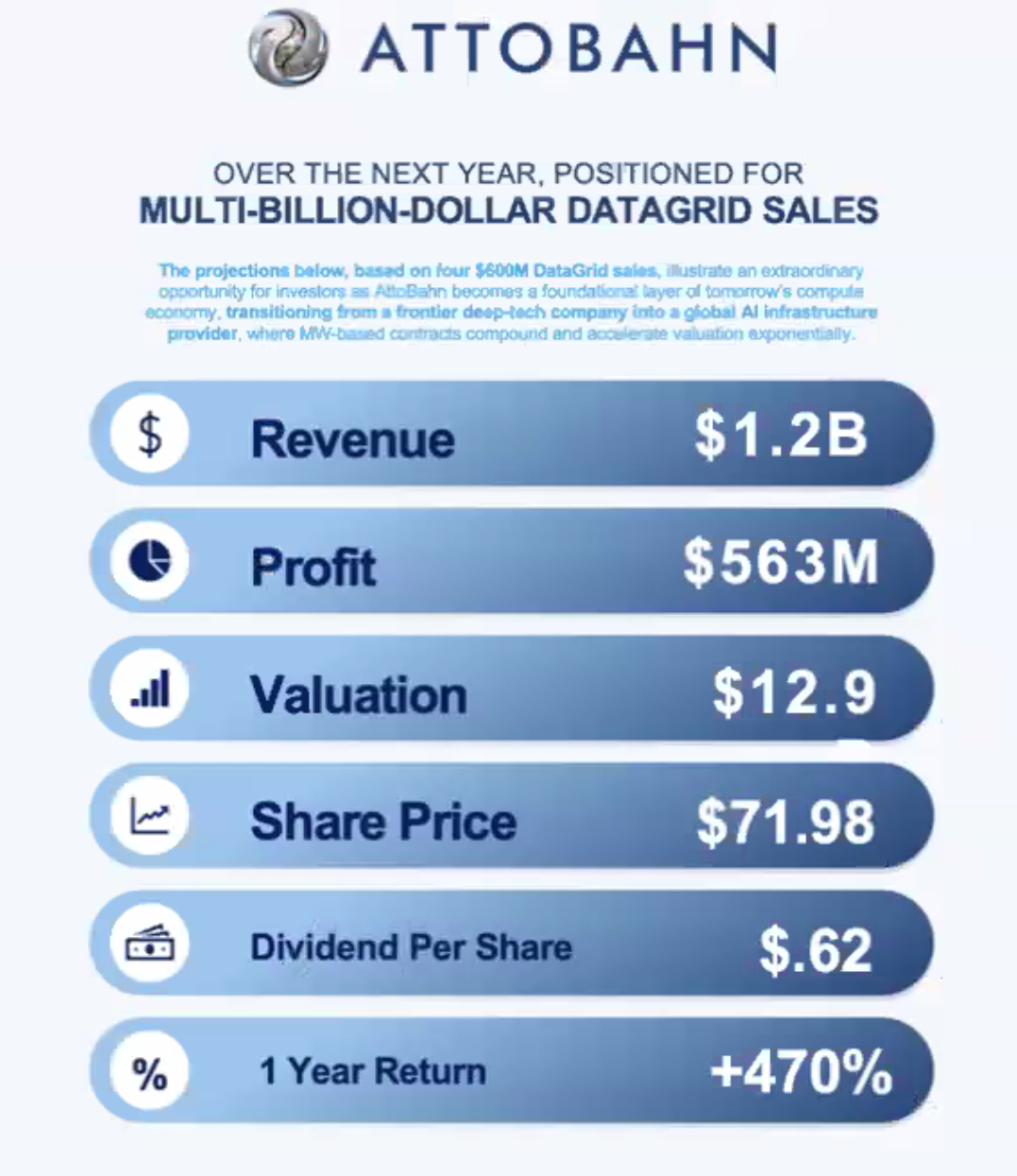
AttoBahn says it can transmit an exabyte of data in under 24 hours over a 10 Gbps connection. It says it eliminates seven layers of internet architecture and replaces them with a proprietary “cell frame” system. It says its infrastructure reduces billion-dollar hyperscaler builds to a $600 million license and a 14,000-square-foot footprint. It says its first year of commercialization could exceed $1 billion in revenue, placing it among the most historically successful tech launches ever recorded.
These are not incremental improvements. These are claims that would rewrite networking physics, telecom economics, and cloud infrastructure strategy.
Yet despite the magnitude of these promises, there are no peer-reviewed technical papers. No third-party benchmarking. No published independent audits. No hyperscaler confirmations. No carrier endorsements. No regulator validation. Demonstration videos are not publicly released. Interested parties are told they may view proof only in controlled environments.
That tension — between sweeping transformation and limited verification — is where this investigation begins.
As we analyzed deal structures, the licensing narrative evolved. Initial contracts referenced $500 million agreements, later adjusted to $600 million. Down payments that were once framed as 10% of the license were later described as 3%, and eventually reduced to only a few million dollars for early adopters. A $2 million convertible note was described as “revenue positive status.” The language around commercialization stages blurred between “Alpha,” “Beta,” and “TR9,” while executives emphasized that terminology should not distract from the opportunity.
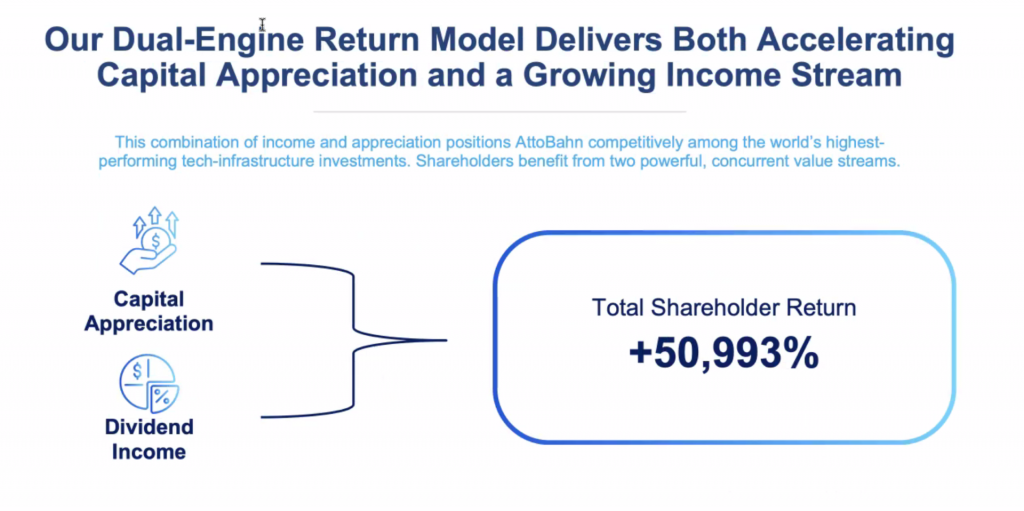
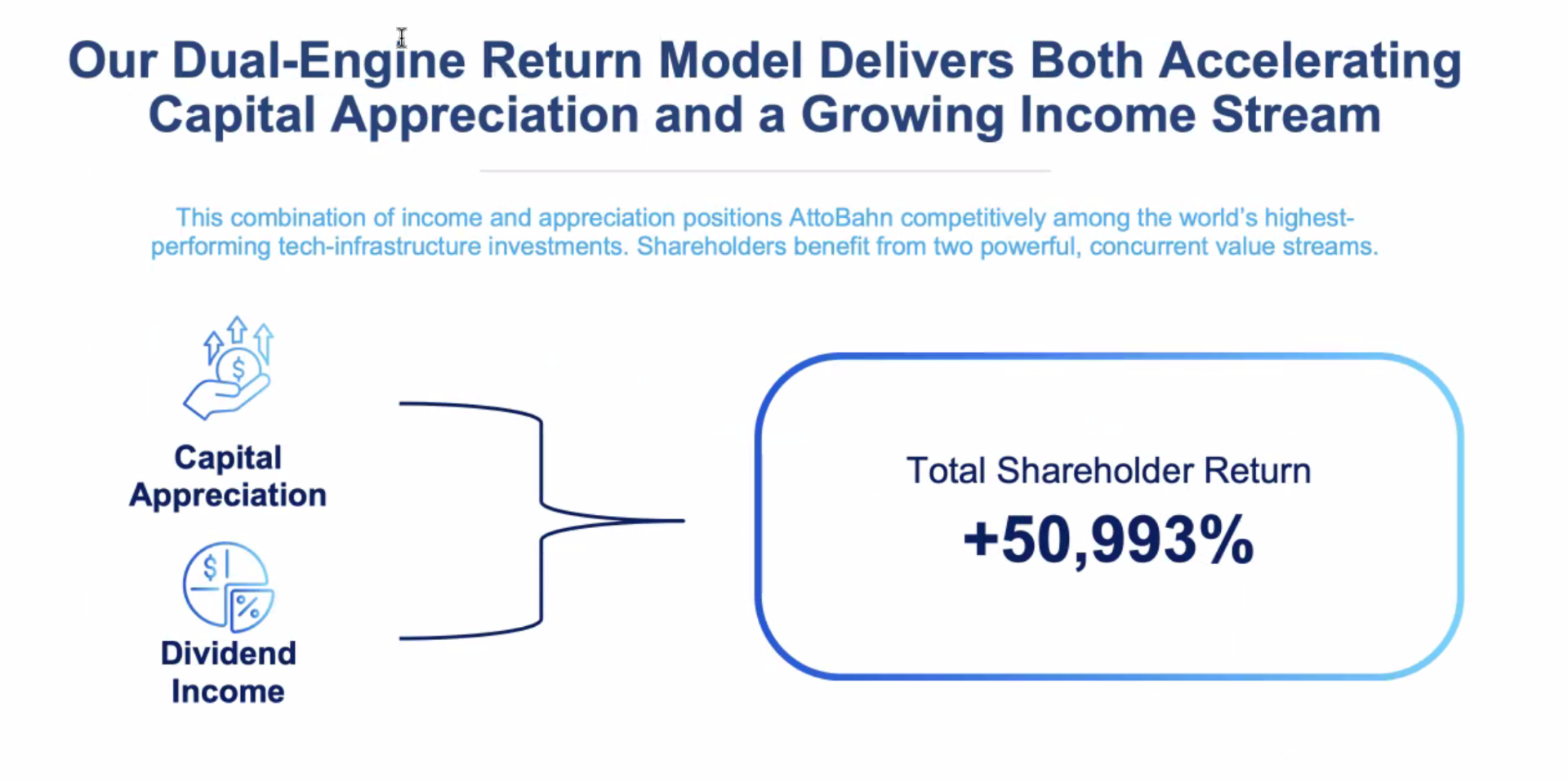
Meanwhile, projections extended far beyond conventional startup optimism. Shareholders were shown internal models describing trillion-dollar valuations within a decade, dividend payouts scaling dramatically, and potential returns exceeding 50,000%. Founders were described as future candidates for becoming among the wealthiest individuals in the world.
Ambition alone is not a red flag. But when ambition is paired with physics-defying throughput math, shifting licensing structures, and promises of historic first-year revenue performance, scrutiny becomes essential.
Another recurring theme is the use of patents as validation. AttoBahn emphasizes international patent approvals across dozens of countries. But patents protect ideas; they do not certify performance at scale. History is filled with patented technologies that never functioned commercially. The presence of intellectual property filings does not answer the more fundamental questions: Does the system operate as described? Has it been independently tested? Do neutral engineers confirm its capabilities?
This homepage is not the conclusion of the investigation. It is the entry point.
In the detailed sections that follow, we will examine:
• The physics and throughput mathematics behind the data transmission claims.
• The evolution of the $600 million licensing model and deposit structure.
• The convertible note framed as commercialization revenue.
• The “Zamaniwave” partnership narrative and what exists in verifiable form.
• The Alpha/Beta terminology and how it aligns — or doesn’t — with industry standards.
• The power-reduction and cooling elimination claims compared against known data center engineering constraints.
• The valuation projections and dividend models presented to private investors.
Our goal is not to mock innovation. Breakthroughs do happen. But when a company asserts that it will replace the global internet architecture, eliminate cybercrime, slash energy use by 95%, and achieve billion-dollar revenue in its first commercial year — all while remaining largely opaque — careful investigation is not cynicism. It is responsibility.
AttoBahn might represent a misunderstood breakthrough.
It might represent aggressive early-stage hype.
Or it might represent something more concerning.
This investigation exists so readers can evaluate the evidence for themselves.
Welcome to the AttoBahn Investigation!
DOCUMENTS
POSTS
- AttoBahn’s “Quantum Speed Network”: a skeptical walkthrough for new readersAttoBahn markets itself as a next-generation “mobile internet” that’s wireless and fiberless, delivering “over 20 Gbps” to each end user while bypassing TCP/IP—the core protocol stack of today’s internet. (attobahn.com)In parallel, its shareholder materials and emails pitch a different (often shifting) story: data-center “DataGrid” infrastructure, licensing deals in the hundreds of millions, and a commercialization… Read more: AttoBahn’s “Quantum Speed Network”: a skeptical walkthrough for new readers
- AttoBahn, Inc.: A Forensic Comparison of Its Website Claims vs. Shareholder Materials
 A forensic analysis of AttoBahn’s website claims vs. shareholder documents. We examine its patents, 20+ Gbps promises, TCP/IP bypass claims, and the gap between patented concepts and real-world telecom deployment.
 - A case study in investor-fraud red flags: Richard Adolphus Forde (a/k/a Euburn Richard A. Forde)
 This article lays out a fact-based public record timeline tied to Richard Adolphus Forde (also known as Euburn Richard Forde) and then translates those facts into practical investor-fraud warning signs you can use when evaluating any private investment. ⸻ Why this matters Investor fraud is rarely “one big lie.” It’s usually a pattern: • bold… Read more: A case study in investor-fraud red flags: Richard Adolphus Forde (a/k/a Euburn Richard A. Forde)
 - How Much of AttoBahn’s Investor Pitch Holds Up? A Forensic Read of Three Shareholder Updates
 How Much of AttoBahn’s Investor Pitch Holds Up? A Forensic Read of Three Shareholder Updates Disclaimer: This is not financial advice. It’s a credibility audit of marketing claims vs. what can be verified from the documents and primary public records. ⸻ Why this review exists Investor updates are supposed to reduce uncertainty. These three AttoBahn… Read more: How Much of AttoBahn’s Investor Pitch Holds Up? A Forensic Read of Three Shareholder Updates